

Similar Sounding Drugs That Turn Into Missed Questions
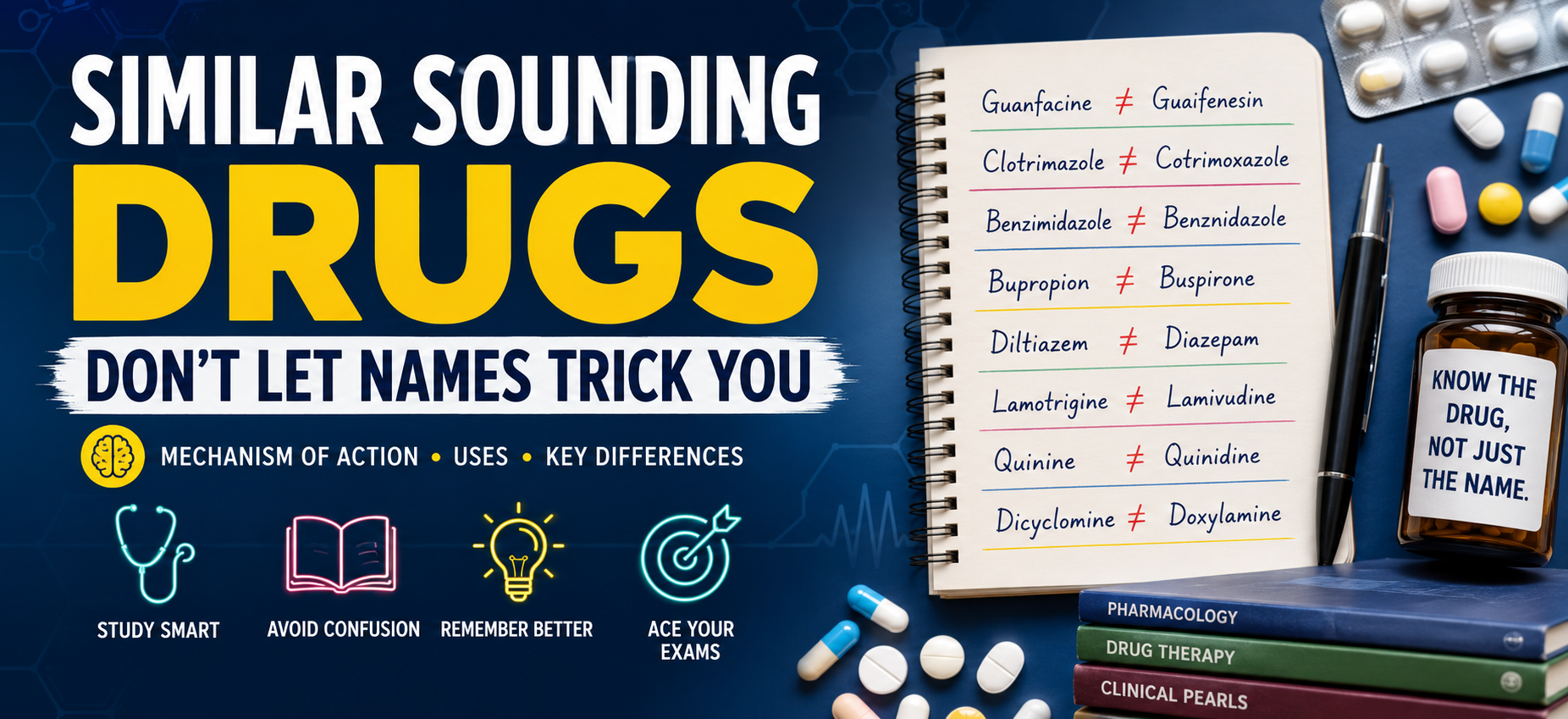
Some drugs are easy to confuse because their names look like they were made to trick medical students. You read one word too quickly, pick the wrong answer, and suddenly it becomes another missed question in your review list.
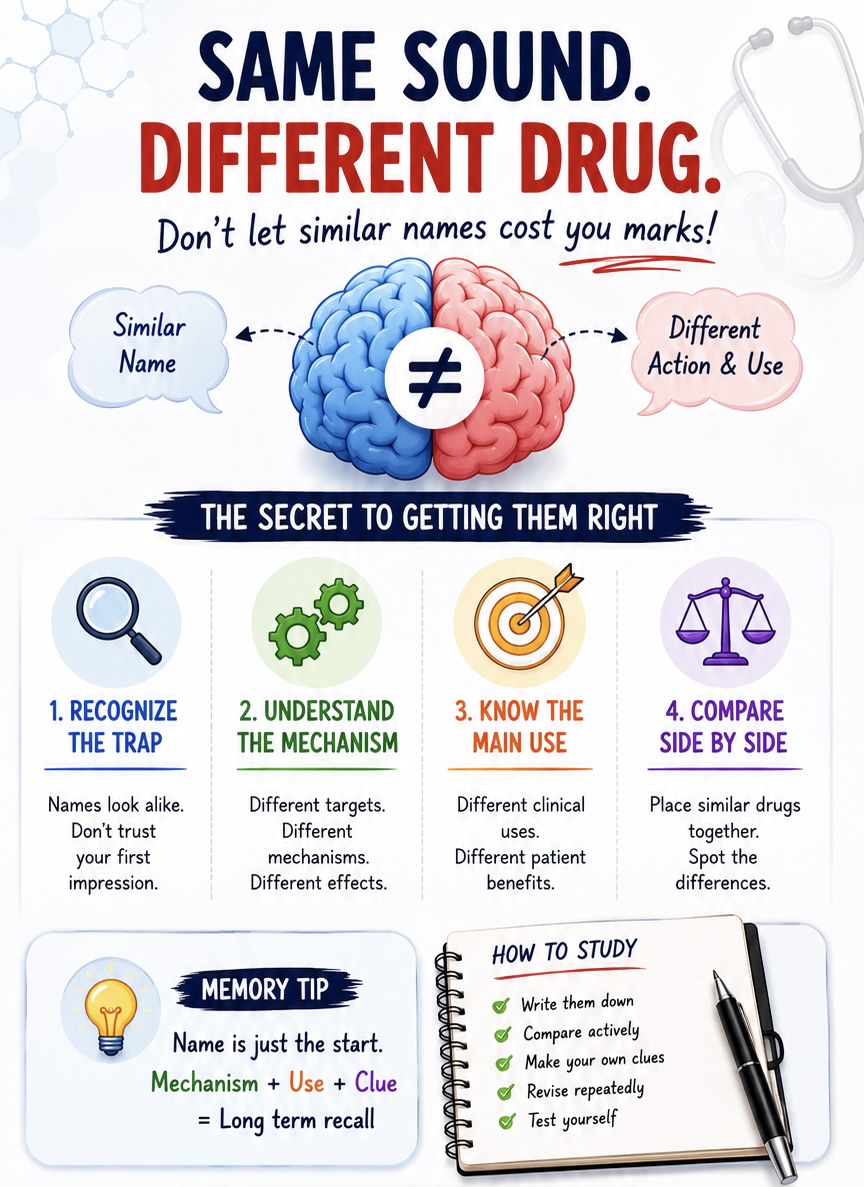
That is why similar sounding drugs deserve their own study strategy. Do not memorize them as isolated names. Put them side by side. Compare their mechanism of action, their main uses, and the clue that helps you tell them apart.
Below are high yield drug pairs and groups that often lead to missed questions.
Guanfacine, guaifenesin, guanidine, and guanethidine
These four sound related, but they are very different.
Guanfacine is a selective alpha 2A adrenergic agonist. It decreases sympathetic outflow. It is used for ADHD and sometimes hypertension. For missed questions, connect guanfacine with attention, impulse control, and central alpha 2 activity.
Guaifenesin is an expectorant. It helps loosen respiratory mucus, which makes coughs more productive. It does not suppress the cough reflex. It helps clear mucus.
Guanidine increases acetylcholine release at the neuromuscular junction. It has been used in Lambert Eaton myasthenic syndrome. Think of it as helping the nerve terminal release more acetylcholine.
Guanethidine blocks the release of norepinephrine from sympathetic nerve endings. It was used as an antihypertensive, but it is rarely used now. It can cause orthostatic hypotension because it reduces sympathetic tone.
Easy way to separate them
Guanfacine calms central sympathetic output.
Guaifenesin clears mucus.
Guanidine increases acetylcholine release.
Guanethidine decreases norepinephrine release.
Clotrimazole and cotrimoxazole
This is a classic missed question trap because one is antifungal and the other is antibacterial.
Clotrimazole is an azole antifungal. It inhibits fungal ergosterol synthesis by blocking lanosterol 14 alpha demethylase. Fungal membranes need ergosterol, so this weakens the fungal cell membrane. It is used for Candida infection and tinea infections.
Cotrimoxazole is trimethoprim plus sulfamethoxazole. It blocks bacterial folate synthesis. Sulfamethoxazole inhibits dihydropteroate synthase. Trimethoprim inhibits dihydrofolate reductase. It is used for urinary tract infections, Pneumocystis jirovecii pneumonia, some skin infections caused by MRSA, some cases of traveler’s diarrhea, and Toxoplasma prophylaxis in AIDS.
Easy way to separate them
Clotrimazole is for fungi.
Cotrimoxazole is for bacteria and Pneumocystis.
Benzimidazoles and benznidazole
These names look dangerously close, but they point to different drug worlds.
Benzimidazoles are a class of antihelminthic drugs. Examples include albendazole and mebendazole. They bind tubulin and inhibit microtubule formation in parasites. This decreases glucose uptake and energy production in worms. They are used for many helminth infections.
Benznidazole is an antiparasitic drug used for Chagas disease, which is caused by Trypanosoma cruzi. It creates reactive metabolites that damage parasite DNA and cellular components.
Easy way to separate them
Benzimidazoles treat worms.
Benznidazole treats Chagas disease.
Bupropion and buspirone
These two are often confused because they both begin with “bu,” but they are used for different psychiatric problems.
Bupropion inhibits norepinephrine and dopamine reuptake. It is used for major depressive disorder, seasonal affective disorder, and smoking cessation. It has low sexual side effect risk compared with many SSRIs. A major exam clue is that it lowers the seizure threshold.
Buspirone is a 5-HT partial agonist. It is used for generalized anxiety disorder. It does not work immediately like benzodiazepines. It is not a sedative-hypnotic and does not have the same dependence risk as benzodiazepines.
Easy way to separate them
Bupropion boosts dopamine and norepinephrine.
Buspirone is for chronic anxiety through 5-HT activity.
Diltiazem and diazepam
These two names can blur together, but they belong to completely different systems.
Diltiazem is a non dihydropyridine calcium channel blocker. It blocks L type calcium channels in the heart and blood vessels. It decreases heart rate, slows AV node conduction, and lowers blood pressure. It is used for hypertension, angina, and rate control in atrial fibrillation or atrial flutter.
Diazepam is a benzodiazepine. It enhances GABA A receptor activity by increasing the enhancing of chloride channel opening. It is used for anxiety, seizures, muscle spasms, alcohol withdrawal, and sedation.
Easy way to separate them
Diltiazem slows the heart.
Diazepam calms the brain.
Lamotrigine and lamivudine
This pair is a great example of why missed questions should be reviewed by pattern, not just by topic.
Lamotrigine is an antiseizure medication and mood stabilizer. It blocks voltage gated sodium channels and decreases glutamate release. It is used for focal seizures, generalized seizures, and bipolar disorder maintenance.
Lamivudine is a nucleoside reverse transcriptase inhibitor. It is used for HIV and hepatitis B. It blocks viral DNA synthesis after phosphorylation inside cells. It is one of the drugs where the name ending can help you. Many drugs ending in “vudine” are antiviral nucleoside analogs.
Easy way to separate them
Lamotrigine is for seizures and bipolar disorder.
Lamivudine is for viruses.
Quinine and quinidine
These two are closely related, but their clinical uses are different.
Quinine is an antimalarial drug. It interferes with the parasite’s ability to detoxify heme inside red blood cells. It has been used for malaria, especially severe or resistant cases in certain settings. It can cause cinchonism, which includes tinnitus, headache, nausea, and visual symptoms.
Quinidine is a class IA antiarrhythmic. It blocks fast sodium channels and also has potassium channel blocking effects. It can prolong the action potential and QT interval. It has been used for atrial and ventricular arrhythmias, although it is not as commonly used now.
Easy way to separate them
Quinine is for malaria.
Quinidine is for rhythm.
Dicyclomine and doxylamine
These two can be mixed up because they both sound like older symptomatic medications.
Dicyclomine is an antimuscarinic drug. It relaxes smooth muscle in the gastrointestinal tract. It is used for irritable bowel syndrome, especially when abdominal cramping is prominent. Because it is anticholinergic, it can cause dry mouth, blurred vision, constipation, and urinary retention.
Doxylamine is a first generation H1 antihistamine. It is sedating. It is used as a sleep aid and for allergy symptoms. It is also combined with pyridoxine for nausea and vomiting in pregnancy.
Easy way to separate them
Dicyclomine relaxes gut spasms.
Doxylamine causes sleepiness and helps nausea in pregnancy when combined with vitamin B6.
How to Stop Missing These Questions
When a missed question comes from a similar sounding drug, do not only write the correct answer. Write the confusion pair.
For example:
Clotrimazole equals antifungal.
Cotrimoxazole equals antibacterial folate blocker.
That kind of review is faster and more useful than rereading a whole chapter. The real goal is not just to remember one drug. The goal is to prevent the same missed question pattern from showing up again.
A good method is to make a three column table:
Drug name
Mechanism of action
Main use
Then add one quick clue that separates it from the similar sounding drug. This makes your missed questions easier to review before exams.
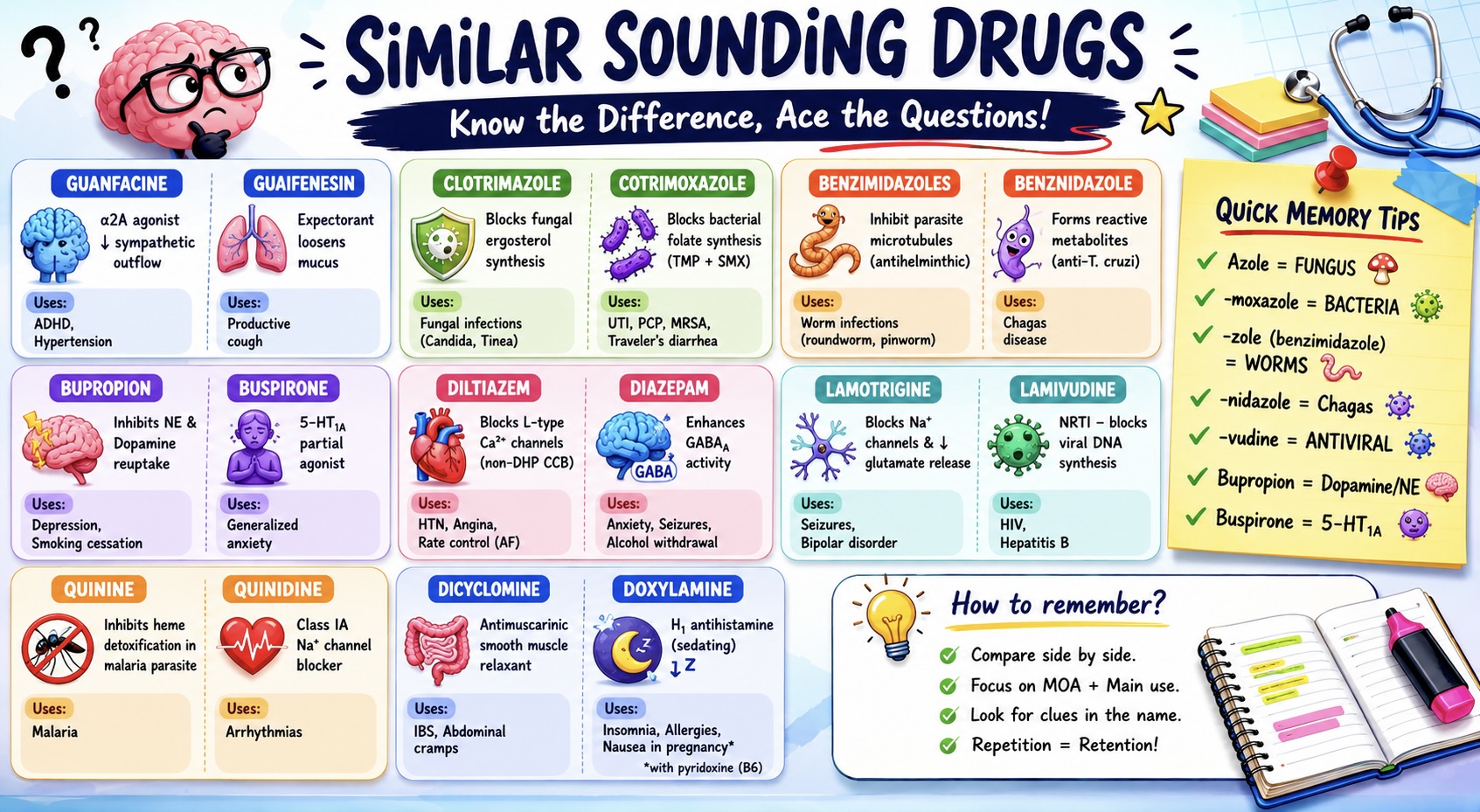
Quick Review Table
Note: Doesn't include all the drugs mentioned.
Final Takeaway
Similar sounding drugs are not just small details. They are a common source of missed questions because they test recognition under pressure. The best way to beat them is to compare them directly.
One drug name.
One mechanism.
One main use.
One clue that separates it from the confusing name.
That is how a missed question becomes something useful instead of something frustrating. Log your missed questions with MissedQ.